Cutting recurring expenses - a handy checklist
Recurring expenses are often the hidden drain on our finances. It’s easy to remember that we ordered a takeaway when we could have cooked or bought a shirt that, on reflection, isn’t a flattering colour in natural light. It’s easy to let our insurance renew without shopping around or stay on a broadband contract that stopped being a good deal months ago. Automated payments are great, but the convenience sometimes costs.
I’ve put together this handy checklist to help you identify where you might be wasting money on recurring expenses. Of course, it’s prompted by the ongoing cost of living issue many of us are facing, but I hope it will remain useful into the future.
I have created a printable version that you can download and use to track your progress.
Check your spending on these categories of recurring payments. Are there ways that you can reduce your costs and/or increase the value for money you receive?
If you are in the UK, use the following resources to research your options and answer the questions below. (Unfortunately, I am unable to provide reliable international resources.)
This checklist has been designed to be as broadly applicable and timeless as possible. If some item are not useful at present or to you personally, ignore them.
Utilities
Ask yourself:
Have I signed a fixed term contract with penalties for ending it early, or could I switch without a cost?
If I could switch without a cost, am I on the best available tariff? Could I find a new deal? If you take up a deal remember to put a reminder in your calendar shortly before it ends to prompt you to shop around again.
If I am mid-contract, would the cost saving from switching be high enough to make it worth paying to end the contract early?
If not, when does the contract end? Put a reminder in your calendar shortly before this date to be ready to find a new deal.
Expense
Gas
Electricity
Other fuel
Mobile (cell) phone
Landline phone
Broadband
Credit repayments
It is usually advisable to avoid borrowing money where possible except in certain cases such as mortgages. Even then, it is usually wise to borrow as little as possible, keep interest rates low and repay quickly. Minimising the interest you pay on credit can save thousands over time.
If you have both savings and debt, you will almost always be paying more interest for the debt than you are receiving for the savings. The exception is mortgage debt and most UK student loans. This means it’s often wise to use at least some of your savings to repay outstanding credit as long as there’s no early repayment charge.
Remember that if you are shopping around for credit, it pays to use an “eligibility calculator” that does a “soft search” on your credit reference file and does not affect your credit rating. Don’t make speculative applications to see what you will get, as these can negatively affect your credit score.
If you have a fixed rate or low cost variable rate mortgage deal that is going to end in the next six to 12 months, speak to an independent specialist mortgage adviser sooner rather than later to get advice on securing the best possible replacement deal.
Ask yourself:
Is there a zero-interest deal available? Would there be a cost to transfer a balance to this?
Will I have to pay an early repayment charge, or could I switch without a penalty?
If not, am I on the best available deal? Could I find a new deal and what would be the costs to switch? If you take up a deal remember to put a reminder in your calendar before it ends to prompt you to shop around again.
If an early repayment charge would apply, would the cost saving from switching now be high enough to make it worth paying?
If not, when does the charge no longer apply? Put a reminder in your calendar before this date to be ready to find a new deal.
Type of credit
Mortgage
Credit cards
Secured loan(s)
Unsecured personal loan(s)
Car loans or hire purchase agreements
Store cards
Other kinds of in-store credit
Overdraft (enter amount of interest paid monthly instead of repayment amount)
Any other credit arrangements
A note about buy-now-pay-later schemes:
Although these are convenient and charge 0% interest as long as all payments are made on time, some mortgage lenders see them as a sign of poor budgeting. Leaving aside whether this is fair, if you are likely to be applying for a mortgage or re-mortgaging in the next six months, it is a good idea to avoid buy-now-pay-later.
General Insurance
Ask yourself:
Do I have the right amount of cover? It’s important to avoid either under-insuring and leaving yourself at risk or over-insuring and spending money on cover that you will almost certainly never need.
When does my insurance renew? Put a reminder in your calendar to shop around six weeks ahead of the renewal date.
Could I save money by changing how I insure my goods, for example, by insuring gadgets through my home contents policy or adding a second named driver on a car insurance policy?
Type of insurance
Home contents insurance
Buildings insurance
Vehicle insurance(s)
Breakdown cover
Travel insurance
Pet insurance
Mobile device insurance(s)
A note about appliance insurance/extended warranties:
Usually these are expensive and poor value for money. If a salesperson is being pushy about these, ask if they are saying that their products are poorly made, unreliable and likely to break down.
If you decide to replace a policy, never cancel the existing insurance until your new policy is live.
Life and health insurance
Making the right choices about protecting your income in case of serious illness or injury and protecting those you love in case you die is a topic that is too complex for this checklist. Please consider speaking to a specialist independent protection adviser about your needs.
If you review your protection insurance cover, or you are considering buying private medical insurance, check what your employer provides. Many employers provide at least some of these types of insurance, often at discounted group rates. However, be aware that if you have to leave your job, for example, because of long term illness or disability, your cover may end.
If you decide to replace any of your existing cover, check your new terms and conditions very carefully to make sure that your new cover is at least as good as your old. For example, if your health has changed, it may be that a new policy won’t pay out for a condition that was covered under your old policy.
If you decide to replace a policy, never cancel the existing insurance until your new policy is live.
Subscriptions
Ask yourself:
Am I using this product or service enough to justify this subscription?
Do I need this tier subscription or would a lower priced tier meet my needs?
Would a pay-as-you-go option be more flexible and affordable?
Have I signed a fixed term contract with penalties for ending it early or changing pricing tiers?
If not, am I with the best value provider and on the most suitable pricing tier? Could I find a new deal? If you take up a special deal, remember to put a reminder in your calendar shortly before it ends to prompt you to shop around again.
If I am mid-contract, would the cost saving from switching or ending the contract be high enough to make it worth paying to end the contract early?
If not, when does the contract end? Put a reminder in your calendar shortly before this date to be ready to find a new deal.
Type of subscription
Gym, fitness and wellbeing memberships
Meal-kits, beverages, snacks, supplements etc
Additional TV channels (cable/satellite/streaming)
Music and audio streaming
Household goods (paper products, cleaning items etc)
Clubs, societies and leisure memberships
Other physical products (e.g. contact lenses, razors, cosmetics, children’s items, pet items, flowers, clothing, hobby/craft supplies etc.)
Magazines and newsletters
Premium bank accounts
Software, web-based services and in-app purchases on mobile devices (e.g. games, downloads, social media and communities, dating, educational, productivity, wellbeing apps etc)
Any others?
Others
You may also choose to review how much you are giving to any charities or religious organisations, or to creators through services like Patreon.
How much richer could you be by this time 2024?
What difference does it really make to upgrade your every day finances? Unless we run the numbers, it’s easy to ignore the changes we could make to how we manage our money. Often these are small actions and the benefits accrue over time, sometimes only after many years.
So, I thought I’d see what I could work out about the difference a few key changes would make in just one year to a typical household in the UK. This was harder than I expected and I had to fudge a few bits here and there. However I think we can get some plausible indicators.
OK, so, an easy one to start off with: cancelling unwanted automated payments. This might be direct debits, standing orders or continuous payment authorities (commonly used for online subscriptions and recurring in-app mobile purchases).
According to NatWest research in 2020 the average wasted on these is £39 a month or £468 a year per household. Coincidentally that’s the same as the cost of signing up to My Year of Action, so if you sign up and we prompt you to take this action, that’s your money back. Everything else is a bonus. Of course, the NatWest number is from before prices started to rise, so it’s probably more now.
What about getting the best buy home insurance instead of just auto-renewing what we’ll assume is a poor deal? At the time of writing, GoCompare reckon they can save at least 51% of their customers £157 a year on a combined policy; Confused.com reckon they can do £163; and Compare the Market reckon they can do £159.
It seems like £160 is a decent ballpark then.
Looking at the same websites for car insurance, a £380 saving seems a realistic figure for this expense.
What about switching a typical balance to a 0% credit card from one charging interest? According to The Money Charity statistics, the average (mean) UK household credit card debt was £2,252 in October 2022. We’ll assume that this is the balance that’s typically carried over each month i.e. that the amount repaid and the additional spending each month are equal and cancel each other out. Apparently, Bank of England data for September 2022 put the average credit card interest rate at 22.2% APR. So shifting that £2,252 to a 0% balance transfer deal saves an estimated £495 if the balance is held at 0% for a whole year. If there’s a 2% fee for transferring, then the saving is £450, which is still nothing to complain about.
How about moving savings from low paying 0.01% AER accounts to a best buy instant access account. Here it gets tricky. I wasted a lot of time trying to get reliable savings figures. The truth is it’s a bit of a minefield because so many households don’t save anything at all that the figures often talk about savings amounts from amongst those who do save. That means the numbers inevitably skew high because savers are on average higher income than non-savers for obvious reasons. If you’re barely making ends meet, you can’t save, certainly not for longer than a few months.
If you look at financial wealth figures that include non-savers, those typically aren’t broken down by product type, so we don’t know how much is held in savings and how much is invested. For example, the median gross household savings in the UK is £12,500 but that includes money invested in shares and other financial assets, so it’s not useful for our purposes. Likewise I found a stat that gave a median amount of £180 per month “saved” per household, but didn’t distinguish between cash savings and investments, so this could be making wildly varying returns from person to person and household to household.
After much trawling around Office of National Statistics surveys, various savings providers and wherever else I could find, the best estimate I could get to was a typical figure of around £5,000 per household in cash savings. If that was being kept in an old instant access savings account of the type often opened automatically with a current account, it could be earnings as little as 0.1% AER or just £5 a year. In which case, moving it to one of the best buy easy access accounts would bring that interest rate up to 3% AER or £150 a year. So that’s a saving of £145 a year.
Shopping around for a better deal on mobile and broadband packages could easily result in savings of £30 a month total, especially if you’re out of contract. That would be £360 a year.
What have we got so far?
£468
£160
£380
£450
£145
£360
£1,963
Cancelling recurring payments
Switching home insurance
Switching car insurance
Transferring a credit card balance (with fee)
Moving savings
Getting deals on mobile and broadband
Grand total
Nearly £2,000 is pretty good going since none of these involves giving up on life’s pleasures. There’s no skipping lattes or declining invitations to brunch on this list. They’re all one and done actions that run in the background of your life just costing less or making you more than they used to do.
The trouble is making the time to actually get these things done.
This is why I created My Year of Action. So you could save your £1,963 and more with just a couple of actions each month that add up to big results. Check it out. I’d love to see you there.
Energy Costs Estimator - how much do my electrical appliances cost to run?
The cost of living crisis is hitting everyone and energy costs are at the biggest worry for many people. Although prices per unit have now been capped, the way this has been communicated to people is confusing and unhelpful.
Many people are concerned about how much they will have to pay for their electricity and they want to know what to cut back. Knowing how much electrical appliances cost to run can help you make an informed decision about using them.
Martin Lewis from Money Saving Expert tweeted this helpful advice about calculating approximate energy costs for your appliances.
This advice is great, but I know many people don’t want to do their own maths, so I’ve put together a quick spreadsheet to do it for you. You can download the sheet for free here with no sign up or other conditions. Just click the button and it’s yours.
I hope you find it useful. If so, I’d really appreciate it if you would share this post far and wide so others can benefit too.
The estimator only calculates a rough estimate of costs, so don’t rely on it to estimate your bills. Please read your meter regularly and contact your supplier to ensure your bills are correct.
If you believe there is an issue with your billing, please contact your supplier. If they cannot help or you aren’t happy with their response please contact the Citizens Advice Consumer Helpline on 0808 223 1133.
They also have online chat specifically for energy problems.
Map your money year
Planning our weekly and monthly spending is how we find the money to repay debts and begin to save and invest. When I’ve talked about this with people in the past, they tell me that they can start to save but “something always comes up”.
Ah yes, the something-always-comes-up effect, or as it’s otherwise known, the occasional spending issue.
If your spending plan only covers the day-to-day expenses that occur every month, then it will seem like “something always comes up” because many months have additional expenses that only occur once a year. If you don’t plan for these, they will always derail you.
So how can you get on top of your occasional spending? Well, occasional expenses can be categorised as fun vs boring types and predictable vs random types.

We’ll start with the predictable expenses because these are where the map of the year comes in. Get a calendar and write in each month any big expenses and also any times when your income changes. For example, if your employer pays a bonus (and you can be very confident you will be getting this bonus) when would that come? Is there seasonal variation in your hours, commission or profits? Mark that in.
This is your money map of the year. It could look something like this*:

Using the map will help you to see if there are particular crunch points in your year when several expenses come at once. You can then work out if any of these could be paid early or delayed to smooth out your costs. It can also help you to be clear during the “good” months how much you need to save for upcoming costs and how much is actually available for a bit of fun.
The random expenses are a bit trickier. You need to think about roughly what you expect them to cost and how often you expect them to happen e.g. if you’re in your mid-late twenties you can expect quite a few of your friends to be getting married and having babies, so it’s a good idea to put a small amount of money aside each month, so you can really enjoy these celebrations when they happen without worrying how much you’re spending.
If you’re a homeowner, you can probably expect one significant repair or replacement every year, so consider how much you’d expect to spend on a new appliance, item or furniture or repair call-out and divide by 12.
Mapping your money year and having a pot of savings (or two) for random costs, brings a strong sense of control and peace of mind. There’s nothing like knowing you’re not going to have to borrow for Christmas and you won’t be caught short by a blocked pipe or a bricked phone.
What is on your map? Can you take a photo and send it to me on Twitter @marthalawton?
*This is not my actual map of the year, it’s loosely based on UK averages.
Reluctant meal planning for low effort frugality
Is meal-planning worth it?
When I realised that meal-planning saved us nearly 40% on our grocery bill, I was shocked. I thought I was already being pretty thrifty. After all, I compare prices carefully looking at £/ml or £/kg rather than assuming that similar sized packages were directly comparable. I mostly resist the discounted items, unless I know we’ll eat them. I default to generics and own brands and only buy a name brand when I knew it really made a difference. I used to go through the supermarket counting in my head “Two people means 14 portions of food for dinners over the week. I’ve got enough chicken thighs for four portions plus a tin of chickpeas, that’s another two portions. That’s three main dishes. Plus vegetable for five portions and we had some leftover salad we can have tonight that’s seven plus…”
What I’m trying to say is, I wasn’t throwing money around. Meal-planning took my thrift to a new level.
I’m not sure why I resisted the idea of meal-planning other than that cooking has always been a creative outlet for me and it felt limiting to plan overly. However, the longer my sweetie lived with me, the clearer it became that he wasn’t always keen on my more experimental dishes and the more I turned to recipes. No complaints, using more recipes has taught me to be a better cook. It also got me meal planning. After all you can’t follow a recipe if you don’t have all the ingredients. How do you have all the ingredients? You decide what you’re going to make before you shop.
So, I began meal-planning and a couple of things quickly became clear:
When we only bought exactly what we needed for the meals we had planned (plus sundries for breakfast, lunch and snacks) we saved a fortune on food that I didn’t even know we’d been wasting.
Meal-planning was boring and took much longer than it seemed like it should. I needed a system to deal with that or I was going to run out of steam very, very quickly.
What are my meal-planning strategies for long term success?
Plan multiple weeks
The first thing to do is to realise that meal-planning one week at a time is asking for trouble. It means you have to find the energy and creativity to make a new plan every single week and who has the time and energy for that? There are so many better things to do. Take a nap, cut your toenails, literally, almost anything.
Instead block out a morning or an afternoon to work out plans for at least four weeks. Once you have four weeks you have enough to rotate between them without everyone getting completely sick of eating the same flipping thing all the time. You can add more weeks later and i advise you to do so.
Use technology
The whole process is a lot easier with technology on your side. I use an app called Recipe Keeper for meal-planning. It can import recipes from websites or scan them from cook-books and then you can tag and categorise them. You can then assign a recipe to a date and mealtime. The app will generate shopping lists, to which you can add toothpaste, bleach etc, and print if you prefer a paper list. There are loads of these kinds of apps. Feel free to experiment until you find one you like.
If you’re not using an app, make list of recipes in a spreadsheet and, for goodness sakes, include details of where to find the recipes in your list. If they’re online, include the links. If they’re in books, include book titles and page numbers. If you must use a paper list, well, you do you. You still need to write down where to find your recipes.
Categorise all the things
OK, so you’ve gathered the recipes you are happy to put in your initial four week rotation. (Remember you can add weeks later, my rotation is up to about nine weeks now.) Now categorise those dishes into groups that make sense to you. Some possible categories: chicken, fish, curries, stir fries, casseroles, slow cooked, pasta, vegetarian, under 20mins. The key to your categories is you want them to be fairly broad, because you are going to use one or two categories for each day of the week.
This is my next big tip for making meal planning easy. When your week has a pattern it makes it much easier to slot dishes into that pattern. It also means that when it comes time to cook you know what category of dish you’ll be making by what day it is.
Our week goes something like this:
Monday - Indian dal with flat breads. I have sooooo many dal recipes - thank you Internet!
Tuesday - East Asian chicken or tofu curry - usually using a ready made curry paste. Quick, simple, tasty.
Wednesday - Pork - usually chops or stir fry. Again something quick and simple.
Thursday - Another vegetarian dish - either the other half of the packet of tofu or something with chickpeas.
Friday - Wild card - maybe fish cakes or pasta or bangers and mash or burgers.
Saturday/Sunday - usually something that takes a bit more time to cook like a stew or braised dish, or else a roast dinner.
Work around the rest of your life
Your plan does not have to look like my plan, but I do want to point out the timing element. Dishes that take time to cook happen on the weekend. Week nights are for relatively fast meals. Pay attention to the schedule of your life when planning your meals. Also consider your energy levels through the week. I have the least interest in cooking on Tuesday nights, so protein plus veggies plus curry paste plus coconut milk is about my level. On weekends I enjoy taking the time to make something to make something a bit more involved. Do what works for you. If your kids do after school sports one day and always come home starving give them something big and solid that day. If there’s a day you are always rushed off your feet then do yourself a favour and put in something minimal effort.
Shop to the plan
This is where the magic happens. When you start shopping to a plan you find your trolley looks weirdly empty. It’s ok, you’ll get used to it. Because you are only buying the ingredients you need to make the things in this week’s you plan, you’re not ‘stocking up’ on random items as you go. It’s amazing how much less you buy when you do this.
Iterate
The chances are your first meal plan is not going to be perfect. That’s fine. Once you have the broad structure in place you can make tweaks as you go. Maybe swap one or two nights around. Maybe take out a recipe that isn’t as popular as you thought. Maybe double up a favourite across more than one week. You might like to keep in a ‘Wild Card’ night like I have, so you don’t get bored and you can try out new recipes.
You might get really into meal-planning and find yourself planning breakfasts and lunches too. All power to you I say!
Do you have any meal-planning tips I’ve missed? I’d love to hear them in the comments.
Money isn't food - do you treat your pay like it has an expiry date?
I have a long-held theory that, on some level, many of us secretly treat money like it’s food. We don’t do it on purpose, but our poor old monkey brains struggle with the concept that we keep a stock of otherwise useless tokens in order to trade them for the things we need later. Why would anyone give you a thing you want in exchange for a useless token? Make money even more abstract (just a number on a screen) and the monkey mind gets completely fuddled. Why are we keeping the numbers high? What use are they? They are only useful when they get us stuff. Stuff is real. Numbers on a screen are not real.
I think for some (read many) people our subconscious minds try to make sense of money by deciding it’s just another type of food that we ‘eat’ by spending it.
It’s well-documented that people whose eating is disordered also often have money issues. This is not only because some eating disorders are expensive, but because the same attitudes of perfectionism, self-denial and shame and around pleasure and self-care that drives much disordered eating, also affects our feelings about money.
So, if we unknowingly, secretly believe money is food and we get the value of it (eat it) by spending it, of course we don’t want to save it. If you save food for too long it goes off. I think some of us deep in some part of our brains believe money will too! This goes double if we’ve never saved successfully before. Until you have saved successfully you have no evidence that money can be stored and not decay.
Of course, the rising cost of living does, to some extent, reduce the value of money saved over time. To make sure money keeps pace with inflation and ideally outgrows it, that money must be put to work, i.e. invested. Here I think we can come to an analogy that might be ancient enough to allow our under-evolved brains to grasp it.
Money isn’t food, or at least it isn’t just food, money is seeds. If you can convince yourself that money is grain you can start to get a feel for what you need to do.
When you get your grain harvest (pay cheque) you don’t grind and eat too much of it, because you need what you can get for future crops. You plant it (invest) in the best locations you find, but maybe not all in the same field in case something goes wrong in that one field and you lose all your crop (diversify). You also hold a bit back in case the crop fails and you need to sow again or in case you miscalculated and your food stores run low (save).
Seeing yourself as a money farmer, instead of a consumer, makes it easier to remember what you have to do to shift away from living pay cheque to pay cheque, and start saving and investing for your future.
Now go out and tend your crops!
Does this post sound like you? Or someone you know? Share it and tag me in @marthalawton on Twitter or @squanderlustpod on Twitter, Facebook or Instagram.
The first time talked about this idea was on the Seize The Moment podcast and you can watch the whole show here or jump to 3:25 where I talk about treating money like food.
Need the willpower to stop overspending? Cut out scratchy clothes labels
Have you ever got up in the morning with the best frugal intentions, then by night time you find yourself looking at an order confirmation email wondering how you ended up browsing for window boxes or signature scents in the first place?
You have just been caught out by ego depletion and you are not alone. Ego depletion is the term for the way your willpower gets drained through the day by the effort it takes to meet the challenges we face. Every time we face a challenge or temptation we have to decide whether to take the option with the best long term outcome or the one with immediate rewards and these are often not the same option. research ahs indicated that willpower is like a muscle and as you use it through the day, it gets tired.
Basically, you can only be patient, tolerant and self-denying for so long before you run out of willpower and do something that feels good in the moment and damn the consequences. That might be snapping at a co-worker, eating a grab bag of Hula Hoops or treating yourself to some fancy new underpants from that store that always emails you.
Let’s face it life sucks sometimes and growing more willpower just because we want to isn’t really an option, so how can we make the best use of the willpower we have?
Get rid of minor irritants
Wherever possible:
Cut out scratchy labels and donate or sell stiff, itchy or tight clothing and shoes that pinch;
Learn about your devices’ settings so you can customise them for your personal preferences;
If there are tools or pieces of equipment you use often, make sure it’s the best quality you can afford, so you’re not frustrated by bad design or shoddy construction;
Ask colleagues, family members, friends and neighbours to change habits they may have that annoy you, it’s possible to have these conversations tactfully and still ask clearly for what you want;
Consider noise-cancelling headphones for times when you need to focus;
Keep your environment at a comfortable temperature, clean, pleasant smelling and uncluttered.
Generally pay attention to low-level irritants that drain your willpower without you even really noticing. The more of these you’re putting up with, the less willpower you have for making positive choices when faced with temptations.
Look after your health
Physical and mental discomfort from poor health is something that drains willpower
Do what you can to get enough sleep;
Eat well so you’re not hungry, sugar-crashing or suffering from indigestion.;
Move your body and stretch often, so you don’t end up stiff and cramped;
Ensure your work environment is as well-designed and ergonomic as possible, so you’re not straining to complete tasks;
Don’t overdo the screen time and stay away from social media drama;
Find ways to relax, ideally somewhere quiet in nature, and take a few deep breaths.
Treat yourself (in moderation)
Pre-emptively doing small, nice things for yourself will help you to replenish your willpower and avoid the need to vent, binge or splurge. This is why no spending plan should completely exclude treats. You know what treats look like for you, make sure you have a supply to keep you going, so you don’t feel deprived.
Celebrate your wins (including times when you successfully exercise willpower). Giving yourself a pat on the back is an immediate reward and takes the edge off the pain of delaying gratification.
Finally, forgive yourself. If you are fighting the willpower war on too many fronts and lose a particular battle, don’t get too down. Instead think whether you’d be better served easing up on one or two areas and focusing your efforts elsewhere. Nobody’s perfect and a constant feeling of failure is a drag on willpower too. If your focus is your finances, just keep everything else ticking over for now. Once you’ have your money in better shape, you can choose a new goal elsewhere.
If you want to hear more about ego depletion and the science behind it, listen to this episode of my podcast Squanderlust: Episode 3. Willpower Outage.
Has working from home fed your online shopping addiction?
We all know online shopping sites have been the winners of lockdown. Even as we begin to open up again, things are still in limbo and, I don’t know about you, but I have that final furlong feeling. Having the end in sight makes the remaining restrictions feel more onerous.
If you’re working from home where there’s no watercooler gossip, it’s tempting to spend break times browsing eBay, Amazon or your other favourite stores.
Feeling bored, stressed and lonely can lead to “comfort spending”. Treating yourself to a little something in the post can, weirdly, feel like someone cares, even if that someone is you.
If you’re relating to this, here’s my top tip for avoiding online shopping on your breaks: schedule something else to do.
I know it sounds obvious, but it’s actually really powerful. Working from home can be much less structured than working at your employer’s premises and a lot of people have complained about a disorientating sense of “pandemic time” passing differently from time in their previous life.
What can you schedule?
A catch up call with someone you actually like
A walk around the block
A YouTube dance party
A short meditation
A short creative or craft activity
Water your houseplants
Play or snuggle with a pet
Read a something fun that’s not thing to do with work - novel or magazine (not online, ideally hardcopy but e-reader will do)
Solve a puzzle
Warning: you might need to set a timer to make sure you don’t overrun (because pandemic time).
The important thing is that whatever you do you’re not on the internet and the activity is relaxing and will refresh you. Note I haven’t included chores in the list, although I suppose if you find housework relaxing you could do fold laundry or pre-prep dinner from time to time. You want to make sure in general though your planned activities are fun rather than practical.
Actively choosing when you’ll take a break and scheduling an activity you’ll look forward to will bring structure to your day and improve your overall well-being as well as reducing the risk of impulse shopping.
And if you really miss getting nice post, you can always send postcards to a few friends and see who sends one back. It’s better than sending things to yourself.
A few weeks ago I was on Podcast from the Past (the postcard podcast) you can listen here.
Understanding the poppadom effect
Who loves poppadoms? I know I do. Crunchy savoury appetisers are my favourites.
You know who else loves poppadums? (Or olives or prawn crackers or bread baskets or whatever…)
Restaurants. You know why?
Because they cost almost nothing compared to the sale price and almost everyone orders them, even customers who intended not to.
In fact, we quite often order little extras we hadn’t meant to buy. Going to the till with a new sweater we see some earrings that would go with it and think we might as well have them. We get a screen protector to go with our new phone. We buy the upgrade, the insurance, the add-on.
Why?
The poppadum effect.
Once you’re already paying for a whole meal, the cost of poppadoms seems trivial in comparison, so why not? The poppadum effect is a type of mental accounting; a way our brains trick us into making unwise decisions by using a cognitive shortcut that doesn’t take us where we really need it to go.
Once you’re committed to purchasing a new tablet (say), adding the cost of a case seems negligible. Shops know this and they play on it. Salespeople are trained to offer the extras after you’ve decided to buy and there are always tempting small items at the till.
The truth is these little extras are often the poorest value for money in the store and if we were thinking clearly, we wouldn’t have bought them at all, but in the moment of purchase we’ve already overcome the resistance to spending and the part of us that always wants more can take its chance and add to basket.
Being aware that this is a common phenomenon can help you make better decisions. I, for example, will always want poppadums, but only one, thank you.
Take a minute when a shop offers you an extra or an add-on and remember you almost certainly don’t need to make a decision about it straight away. Say you’ll think it over, because nine times out of ten you can come back for it. You might even get a discount.
I did a podcast episode on our weird irrational responses to prices. You can listen here.
When is a budgeting issue not a budgeting issue? (A blog post for freelancers)
When you’re a freelancer working out what you can afford to spend can be a nightmare. I mean, it’s ok if you’re established and making the big bucks, but what about when you’re just getting going, or if you’re in a field that’s more known for passion than paycheques?
How do you plan your spending when you don’t know how much money you’re going to have until you’ve got it? When you’re living job to job and struggling in between, it can feel like everything is out of your control.
I have lived this life. I know this issue well. I hate to tell you this, but this probably isn’t a budgeting issue, this is a business issue.
My first question for people in this situation is this: are you sure you don’t know what you’re going to make and when? Why not?
Many, many types of freelance work have a pattern to them; some are seasonal and follow the weather, or the academic year, or certain holidays. Others just tend to go through a cycle (pitch, contract, set up, work, close, payment) with relatively predictable timescales for each stage.
If you haven’t figured out the time patterns for your freelance work, it’s worth taking a few hours and trying to do so. These patterns determine when you get paid and that is vital information.
If you’re not a business-y type you probably avoid words like ‘cashflow’ but you’ll be familiar with the dreaded phrase ‘feast and famine’ or as I like to call it, having a lumpy income.
But unless you smooth out those lumps you’re always going to struggle, so go back through your invoicing, go back through your work calendar and look for the patterns.
Once you know roughly what happens with your work you can plan how you’re going to manage both your time and your money better. For example, your pattern might include something like this: “everyone needs my outputs about six weeks before the major holidays and seasonal events. I tend to get paid about two weeks after that”. So you can plot when those holidays and events come and reckon on getting paid about a month before each. Or else find another income stream with the opposite seasonal pattern to balance you out.
Or your pattern could be “it takes an average of six weeks from pitching to starting work, eight to finish a project, and another four from finishing work to getting paid” You know that you need to start pitching at least four weeks before work on each job ends, so you aren’t leaving a huge gap between projects and struggling for money if an invoice becomes overdue. You could also consider setting up your contracts for part payment midway through to prevent the gaps from getting too long.
Once you start paying attention to this, you’ll feel much more in control of what’s happening in your work. You can start looking for solutions and that will give you confidence as you promote your work.
It will also allow you to plan your spending, so you know how long you’re likely to have to make each payment last and you can make sure bigger essential outgoings tally in with times when you are confident of having more money.
Your daughter's spending plan
This is the final post in my series on different ways to budget a steady income. You can hear more discussion of the different methods here on my podcast, Squanderlust.
This method is actually a digitised version of the old school ‘envelope’ or ‘jam jar’ method. Hence the name. To do this, you’ll need an account with one of the new app-based ‘challenger’ banks - Starling or Monzo. It uses their spaces (Starling) or pots (Monzo) features to manage your spending. These features are usually marketed as a way to save for goals and they can certainly be great for that, they can also be used for controlling normal monthly spending.
How to
You will need to decide what your spending types are. I suggest keeping things simple and having no more than ten. These should be a combination of your day to day spending (e.g. groceries, clothing, transport) and occasional spending (e.g. repairs, device upgrades, gifts). Both Monzo and Starling have built in categories for types of spending, which they use to label your payments out so you can see where your money is going. You can choose to base your types on their categories or create new ones if theirs don’t quite fit.
You’ll need to work out how much money you need to cover each type of expense and I talked about this in a previous post in this series. This is your spending plan. The difference in this method is how you keep track once you have the amounts worked out.
Now make a pot or space for each type of expense.
When your income comes in, sort it into the pots/spaces according to your spending plan. Monzo has a Salary Sorter function which can help with that. You’ll need to do it manually with Starling.
Monzo has a function which allows you to nominate a bill to come from a specific pot, so you can name one pot “bills” and have all your direct debits/standing orders come from this pot.
If you have a Starling account you’ll need to keep the money for bills outside of your spaces until all the bills are paid, so you will want to make sure your bills come out of your account ASAP after payday.
Alternatively you might prefer to combine this with the ‘multi-account method’ from my previous post and have a completely separate account for bills. If you want this separate bills account also to be with Starling they charge a fee of £2 a month. You may decide this is worth it to get the additional control of splitting your bills from your spending while also keeping all your accounts with one provider.
Now when you spend money, pull down the same amount of money from the relevant space or pot, so you know what you have left to spend on each area of your life.
If you need to meet an occasional expense, transfer the relevant amount from the relevant pot to the main account.
If you are extra frugal one month and have money left in your spending money type spaces/pots on pay day, transfer the extra to an occasional expense pot/space or, if these are already looking healthy, into an actual savings or investment account where you can get a good return.
Let’s talk about the advantages and disadvantages of this method.
Pros and cons
The pros:
This is a relatively low maintenance way to control spending and make sure you have enough money to cover bills and save for short term goals.
It’s more mindful than the multi-account method. If you’re spending more than you intended, you can tell fairly easily where the over-spend is coming from.
Although it’s an all digital method, this has the advantages of a cash budget method. The amounts left available for each type of expense are very clearly visible whenever you go into the app.
As with the multi-account method, as long as you err on the side of caution each time, you can be a bit rough and ready in your calculations and still be ok. For example, if you know your phone bill is typically £17-20 then as long as you leave £21 in your bills account/pot for it, you know you will be ok.
You are almost certainly never going to get a charge for a bounced direct debit or an unpaid bill.
While you’re out and about, you can tell straight away if you can afford to treat yourself now or if you’ll need to wait. No need to consult your spreadsheet.
Very easy to sustain. If book-keeping style budgets don’t work for you and become overwhelming, this will almost certainly be a better choice.
Don’t have to remember to request/keep your receipts.
The cons:
May need to switch banking providers, which can have an impact on your credit record.
Takes time to set up.
Need to be comfortable with app-based banking.
Need to spend time moving money between the pots.
Need to be sure any automations are working correctly, have the right amounts and come out on the right days.
Unless you create a single “occasional spends” pot/space, you may find you need to pay for a particular item before you have saved enough e.g. if the washing machine breaks suddenly. This might mean you have to transfer between the pots/spaces for this type of spending to make up the difference.
What do you think? Would this style of spending plan work for you?
To hear more about different ways to plan and track spending, check out my podcast Squanderlust Episode 7 : Budget Pick ‘n’ Mix
The multi-account method
Today we’re going to get into budgets for people who really hate the admin side of budgeting. This is a way to automate parts of the control of your spending and make certain you have money ringfenced for bills and savings before you can spend anything.
How to
For this method you need three accounts, two basic or current accounts and one instant access savings account. The first current or basic account is for bills and other automated payments. this needs to have direct debit/standing order facilities. The other basic/current account is for spending money and it needs a debit card. The instant access savings account is for keeping money ready for occasional spending - things like birthdays, household or car repairs and religious festivals. It may be useful if this is with the same bank or building society as the spending account, so you can easily transfer between them.
You’ll need to work out how much money you need to cover all your expenses and I talked about this in a previous post in this series. The difference here is how you keep track once you have the amounts worked out.
Ideally, you should get income paid into your bills account. You will need to know how much needs to stay in this account to cover your bills until next payday. I suggest you keep back a little bit more than this amount, in case any of the bills is higher than expected.
Then decide what needs to be paid into your savings account to cover the occasional costs. If this will be a consistent amount, you can set up an automated payment to the savings account. Alternatively, you can make the transfer manually on the day you get paid.
Decide how much you want to go into longer terms savings and investments and, ideally, automate these transfers too, then you can treat them like a bill.
Finally, transfer the amount you want to use for day to day living expenses into your spending account.
If you need to meet an occasional expense, transfer the relevant amount from the instant access saver to the spending account.
You’ll need to keep an eye on how much is left in your spending account throughout the month. You should also schedule some time once a week/month to go though your bank statements/online banking. That way you can be sure that there are no unexpected payments and that the amounts you have going into each account are still appropriate.
If you are extra frugal one month and have money left in your spending account on pay day, transfer the extra to the occasional expense savings account.
Let’s talk about the advantages and disadvantages of this method.
Pros and cons
The pros:
This is a low maintenance way to control spending and make sure you have enough money to cover bills and save for short term goals.
Although it’s an all digital method, this has many of the advantages of a cash budget method.
As long as you err on the side of caution each time, you can be a bit rough and ready in your calculations and still be ok. For example, if you know your phone bill is typically £17-20 then as long as you leave £21 in your bills account for it, you know you will be ok.
You are almost certainly never going to get a charge for a bounced direct debit or an unpaid bill.
While you’re out and about, it’s very easy to see at a glance if you have spare fun money this month, or if you need to tighten your belt. No need to consult your spreadsheet.
Very easy to sustain. If you’re someone who has started multiple book-keeping style budgets in the past and never kept up with them after the first couple of weeks, this willll almost certainly suit you better.
Don’t have to remember to request/keep your receipts.
The cons:
Less likely to spot a fraudulent payment quickly.
Need to be sure your automations are working correctly and come out on the right days.
Less familiar with the nitty-gritty of your spending, so less likely to spot opportunities to save money, without additional effort.
Requires multiple accounts, probably with at least two different providers.
What do you think? Would this style of spending plan work for you?
To hear more about different ways to plan and track spending, check out my podcast Squanderlust Episode 7 : Budget Pick ‘n’ Mix
Book-keeping-style spending plans
Today I’m going to talk about the type of spending plan that most people mean when they talk about a “budget”. That is to say, a list of sources of income and a list of types of expenses and payments to savings/investments with weekly or monthly amounts of each beside them, so you can add up each list and check they balance. Actual income and spending is then tracked against the lists to make sure you’re not going outside your plan.
Let me give you an example. This is a plan for two parents on a moderate income with two kids and in a rented three-bedroom house with two cars to run and no pets.
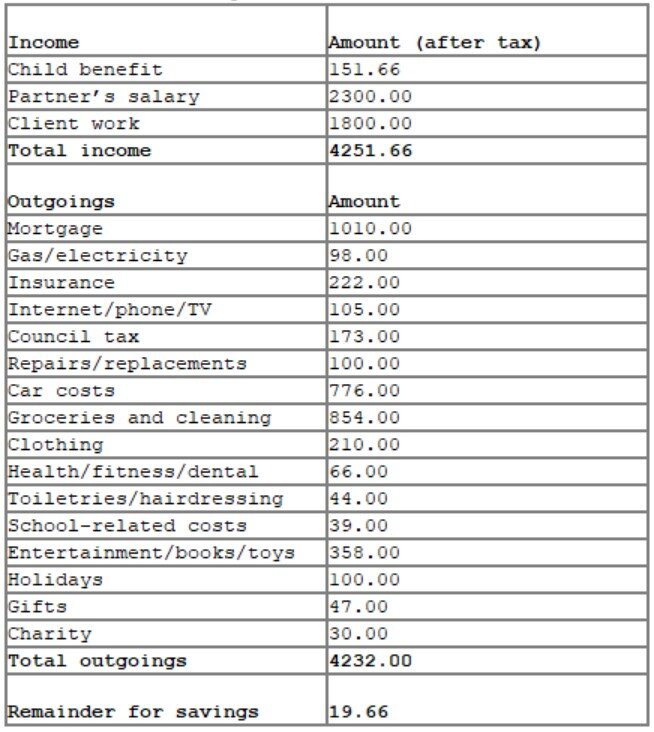
Leaving aside the actual amounts here*, let’s talk about the advantages and disadvantages of this method.
Pros and cons
The pros:
You know exactly, and I mean exactly, what’s going on with your money at any given time.
You can catch any risk of overspending immediately before it happens.
You can spot fraudulent payments and rising costs immediately and do something about it.
The cons:
Time consuming - this is the biggest one, it takes time and effort to set up and then time to maintain.
If your spreadsheet or app goes wrong somehow, then things can get very frustrating.
You need to be consistent with it and build it into your routine.
May need to get into the habit of asking for/keeping receipts or you’ll have unaccounted spends which can quickly pile up.
If you think this method could be for you, here’s how you create a plan this way and make it work.
How to
You can do all the calculations on paper, but it’s easier with a spreadsheet and most spreadsheet programmes come with personal or family budget templates galore. There is also one on Money Saving Expert, StepChange and honestly, practically every money blog out there. You can also make your own. Alex did after we recorded this episode of Squanderlust and you can find out how she got on in this episode. I used to use this template, but I don’t use this method personally, any more.
If you’re going to build your own spreadsheet, you need to know what calculations need to go into it, so let’s talk about that. If you hate maths and will be using a template, you can skip this, but I promise it’s all very easy maths.
Weekly or monthly?
The first thing is that your spending plan needs to be for either weekly or a monthly spending. There isn’t a hybrid method. Weekly makes it easy to track smaller amounts of money and day-to-day spending. Monthly works better for bigger overall amounts, monthly salaries and bills paid by direct debit/standing order.
Our spending, however, usually comes in a mix of weekdays, daily, weekly, monthly and longer time periods. So we need to do some conversions.
To convert to weekly:
= weekday spend x 5
= daily spend x 7
= monthly spend ÷ 4.33 (because there are 52/12= 4.33 weeks in a month, not 4)
= quarterly spend ÷ 13
= annual spend ÷ 52
To convert to monthly:
= weekday spend x 21.66 (because 21.66 = 5 x 4.33)
= daily spend x 30.32 (because 30.32 = 7 x 4.33)
= weekly spend x 4.33
= quarterly spend ÷ 3
= annual spend ÷ 12
I don’t wanna do maths or spreadsheets
That’s fine, there are loads of online calculators that do this for you. Two examples that come to mind straight away are The Money Charity’s Budget Builder and the Money Advice Service Budget Planner. There are lots of great phone apps that do it too, but we’ll leave those for another day. You can also do a different style of spending plan altogether.
Make it accurate
I can’t emphasise this enough, your plan must be based in reality. If you fudge it you won’t be able to stick to it. How do you make it accurate? Look at the actual figures. Use bank statements, receipts, payslips, benefits entitlement letters, bills and so on to work out how much money actually comes into your household and where it goes.
This is often the point where people give up from sheer shock at the real numbers, which can seem very discouraging. They don’t have to be though. They’re your starting point, not your end point.
You can set targets to change the numbers as part of your plan. If you realise you’re spending more than you thought on energy, you can look at ways to cut your electricity bills. If you’re spending way over the odds on your phone tariff, that’s something you can switch up. If your grocery bill is twice what you thought it was, you can research tips on thrifty meals and avoiding food waste.
A note on occasional spends
One thing that wrongfoots people doing this style of spending plan is occasional spends. Birthdays, Christmas and other religious festivals, household repairs, replacement gadgets, school uniforms and trips, new tires and the like all need to be in your plan or you will never have the money for them and you’ll always feel like you “can’t budget because something always happens”. If they’re in the plan, you can put money aside for them each month. Build up a pot of cash in an instant access savings account ready to cover them. Work out what you expect to spend on each of these types of costs every year and treat like an annual cost as above.
Balance your budget
This is the moment of truth, when you add up all your expenses and take that away from the total of your income sources, what do you have left? If there’s money left over, happy days, you can put that towards saving and investing for your future. If not, then at least you can investigate where the issue is and look for fixes. If things are looking very bleak, don’t delay contact a debt adviser. If the idea of that feels uncomfortable, we talked about why it’s good to get advice early on the podcast, including a description of what happens when you go for debt advice, so you know what to expect.
Once you’re happy you’ve got your outgoings below your income and enough going towards your future needs and wants, take a moment to admire your plan. Congratulations on your hard work.
Wait there’s more!
Lots of people get this far and then stop, but I’m afraid this is the beginning not the end. A plan is pointless if you don’t act on it. Now you need to actually track your income and spending against your plan. It’s usually best to do this daily, or at least every other day. Miss this step and the whole ‘making a spreadsheet’ bit was a waste of time. You need to actually make sure you spending no more than you planned and that your allowances for your different categories were appropriate.
Once you start tracking, you might find that your plan was a bit out here and there. It’s pretty common to get it wrong the first time. That’s ok, you can adapt and update it as necessary. As you get better at finding ways to be thrifty, you can start putting more towards paying down borrowing or into savings and investments. Or, if you’ve been being a bit over-frugal, you can re-introduce some fun and creature comforts into your life, safe in the knowledge that you can afford them, because they’re in the plan.
(*this family could probably save loads on some areas and other areas the figures might be unrealistically low)
Would this type of spending plan work for you? What do you think?
To hear more about different ways to plan and track spending, check out my podcast Squanderlust Episode 7 : Budget Pick ‘n’ Mix
Mix it up with the cash combo spending plan
Last time I talked about the all-cash spending plan and the pluses and minuses with it. The most obvious minus is that paying bills in cash often incurs extra charges and is a giant faff.
Introducing the cash combo plan. All the convenience of electronic payments, just as tangible and intuitive as the all-cash plan.
Here’s how it works. You set up automated payments for all your bills, savings, insurances, and credit repayments. Make sure there’s enough in your current account to cover these each week/month, plus a little bit of extra, in case any of the bills is higher than expected. Then you withdraw the money for your spending including both essentials like groceries and more fun things like renting a movie.
You can treat the cash like you do for the all-cash plan, sorting it into envelopes for different types of expenses.
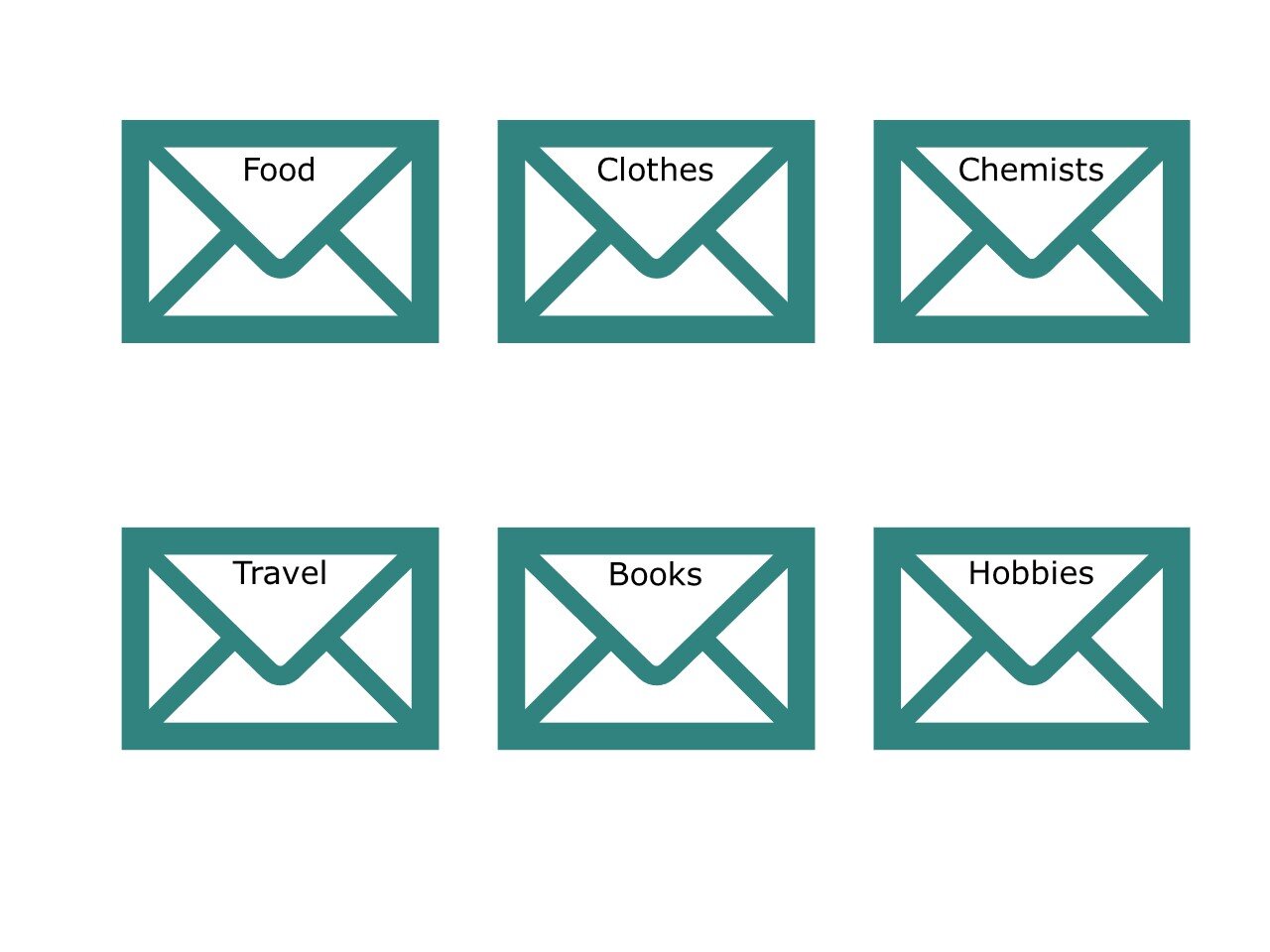
You’ll probably need more envelopes than this, especially if you have children.
Alternatively you can just have two envelopes, one for “essentials” and one for “non-essentials”. The key is to be over-generous with the “essential” envelope and not take money out of it, except for your those essential expenses, until you get to the end of the week/month. The one downside with doing things this way is you’ll know less about where your money is going than with the “types of expense” version.

Two nice, big, fat envelopes. More simplicity, less control.
At the end of the week/month if there’s still money in the “essential” envelope, you can decide whether to put it back into a savings/investment account or to treat yourself.
One thing to bear in mind is that because bills are easier to manage on a month by month basis but spending is easier to manage on a week by week basis, you may also choose to withdraw your spending cash weekly or to withdraw for the month, but have weekly envelopes.

You do know only February has four weeks, right?
So, what do you think? Would you find the cash combo spending plan useful?
For more on different ways to create a spending plan listen to my podcast, Squanderlust.
Going old school with your grandma's spending plan
Our first way to craft a spending plan (or budget, if you must) is the most low-tech way imaginable. This is a method that people used for centuries. Before there were debit cards and challenger banks and smartphone apps there was the all-cash spending plan. Your grandma or great grandma may well have used a system like this and with good reason. It’s simple and it works.
This way of planning spending has a few other names. People also call it the cash diet and, for reasons that will become apparent, the jam jar method or the envelope method.
Here’s how it works.
Take all your money for bills and spending for the week or month out of your account. Transfer the money you’re putting aside for future savings and investments into the relevant accounts.
Label a set of containers with the expenses you have to pay (fuel, water, food, clothes, children’s activities etc). Envelopes or jam jars are the classics, but a set of ziplock bags will work, or the zip-up pockets in a personal organiser.
Share your money out between the containers. Start with the most important bills i.e. housing costs, fuel, TV licence, council tax, and work down. Only spend from the correct containers, try not to swap money between them. Do not take money out of the containers for covering bills to pay for other costs. Have one container for emergencies and add to it each month. Wanting a bottle of wine is not an emergency.
Pros and Cons
This is a straightforward system and it can’t be fudged. The money is either in a container or it isn’t. This makes it a very tangible, intuitive system for people who struggle with focusing on the numbers on a screen or connecting them to their real life purchases. If your maths is a bit iffy, this requires much less calculation than other systems. You just share out the cash until everything is covered.
It’s also great if you have had a tendency to tell yourself it’s ok to overspend because you’ll “make it up later… somehow”. It makes it very clear there is no making it up “somehow”. The only way to make it up is to cut down spending on something else.
Of course, there are downsides. Most of us don’t want to pay all our bills in cash, even if we have the option. Automated billing saves a lot of time and effort and as long as the money’s there, you know your payment won’t be late and affect your credit score. Moreover, there are obvious security risks to keeping lots of cash in your home and most of us want to avoid those.
We’re moving to a cashless society and some shop assistants will look at you sideways if you pay cash, especially for bigger ticket items. They may think you’re involved in some kind of shady activity and trying to launder the money (although, for real, no one launders money that way, not efficient enough for the sums involved).
Depending on where you live there may not be a cash machine local to you, so making the weekly/monthly withdrawal may take planning. No one wants to spend extra on travel just to get their money if they can help it.
Still this is a solid way to plan weekly or monthly expenses for anyone who wants to get a really tight rein on their spending.
What do you think? Is this something you would ever try?
To hear more about different ways to plan and track spending, check out my podcast Squanderlust Episode 7 : Budget Pick ‘n’ Mix
The pros and cons of budgeting
Ugh… budgeting.
No one wants to, we all know we “should”, and if you read any personal finance blog you’ll be told you must, because it’s the foundation of good financial management. There will probably be the classic quote from Mr Micawber, the literary patron saint of debtors:
‘My other piece of advice, Copperfield,’ said Mr. Micawber, ‘you know. Annual income twenty pounds, annual expenditure nineteen nineteen six, result happiness. Annual income twenty pounds, annual expenditure twenty pounds nought and six, result misery.”
David Copperfield (1850) by Charles Dickens
This is true enough. Money out must be less than money in, or it all goes horribly wrong.
Even so. Ugh…. Budgeting.
One reason, I think, why the personal finance experts who urge us all to budget can come across a bit… dare I say, preachy, is because they only acknowledge the upsides to planning and tracking your expenses. Many don’t like to mention the reality that there are downsides too.
Now in my opinion the downsides are more than outweighed by the upsides, but it’s disingenuous to pretend they don’t exist.
So I’m going to be really frank and give you the pros and cons and you can decide for yourself.
First the downsides.
It’s boring. Simple really. There are lots more exciting and interesting things we could be doing with our time than tracking our spending. Some people get really into it and good for them, but, in general, it’s a chore. Most of us don’t want to make admin our hobby.
It takes time. Related to 1. is the fact that there are only so many hours in the day and many other activities, not to mention people and pets, that want our attention. You may also have planned to spend quality time with kids, partners and friends, stay hydrated, exercise, meditate, keep up with hobbies, read enough of the news to have semi-informed opinions about the world and maybe, I dunno, do whatever your employer or customers pay you to do. Adding in time to plan and track your spending can feel like the final straw for an overloaded schedule.
It can be depressing. If you’re used to just crossing your fingers and getting by on hope, reality can bite hard when you finally face it, and creating a spending plan means you do have to face reality. There’s no point in writing a plan that isn’t based in fact. This is one of the biggest hurdles to a lot of people’s budgeting. They just don’t want to know how bad things are.
It can cause regret. There’s nothing like making a positive change, to make you regret not having changed sooner. Especially when it comes to stopping overspending and starting to save and invest. It brings you up short against all the ways you’ve wasted money that could have gone on a better financial future.
No spending plan, no need to feel those pesky regrets today. Ta da! (never mind that they’re waiting around the corner.)
Maths. (I mean, it’s only basic arithmetic and there are lots of apps and spreadsheets that will do it for you but still… I know anything to do with numbers bothers a lot of people.)
You may have to give up on some of your pleasures. This is another big one. It’s easy for us to convince ourselves that things we want are in fact “necessities” or that we just can’t save “this month” but we will next month when we’re magically better people who don’t shop so much and buy fewer takeaways.
A spending plan makes it clear how much we can actually afford to spend on shopping and takeaways (or e-books and in-game purchases or whatever tends to tempt you). There’s no getting away from it, something will have to give and it’s probably some of your fun money. Do. Not. Want.
OK, that’s enough downsides. If I’ve forgotten any, tell me in the comments.
Let’s look at the upsides
You know exactly where you are. This is key. Knowledge, as they say, is power. Without a plan you’re constantly guessing about whether you can afford the things you need or want. The truth is you’re probably making mistakes all the time.
Do you have enough money for that day trip? …maybe… If you go, will you have enough for your friend’s birthday present at the end of the month? … you hope so…
With a spending plan you can answer those questions. You can go on the day trip as long as it doesn’t cost more than £45, that way you’ll still have £20 for your friend’s present.
You can find relatively painless ways to save. A spending plan can be a great motivator to switch up your utility, credit and insurance providers so you can find more money for fun and savings. With a plan you can see straight away how doing this will benefit you.
You can get greater value from your spending. It may be that you’re spending on non-essentials in ways that are costing more than you realised and don’t actually bring you joy. Having a plan will show you what’s really going on and help you focus your spending on what you value most and away from the trivial.
You can spot frauds, errors, and price increases straight away. If you’re tracking your spending and bills every month against your plan, then you’ll notice if something doesn’t add up. The minute your mobile phone company increases your bill, you can find a new plan. If there’s a payment you don’t recognise, you can query it. If you’re charged twice for the same thing you can request a refund. Giving money away for no reason? No thanks!
You can plan to pay occasional expenses out of savings, not credit. Household repairs? You can put the money aside for that. Birthday and other celebrations? They’re in the plan. School uniforms? Covered. A nice meal on your anniversary? Heck, yeah!
Even if something essential is more than you thought ("New brakes to go with that MOT, Madam?") and you have to shuffle money out of, say, your holiday fund, or even put the difference on a credit card, you’re still better off than if you had no plan at all and needed to find the whole sum out of nowhere.
If you need to say “no” to a pushy salesperson or a whining child, you can do so assertively, because you’re clear about what you can afford and what you can’t. You can also say “not yet” if you will have the money later on, which brings us to the next upside.
If you have children, you can set a good example and help them learn positive money habits. By telling your children “we don’t have the money for this yet, but we’re saving up” you’re encouraging them to do the same for the things that they want.
You can build an Emergency/Rainy Day/ F*** Off Fund. Start with saving one month’s basic expenses, then build up to three months and eventually between six months to a year’s worth. Then if you can’t work or you have a sudden big expense, you’ll know you’ll be ok.
You’ll be surprised what you can afford. Remember the day trip in point 1? Without a spending plan you might assume you couldn’t afford to go because of your friend’s birthday and then you’d miss out.
What’s more, planning spending allows you to save for goals that may previously have seemed completely out of reach. These could be things like a good camera and a set of fancy lenses, a really gorgeous winter coat, a high-powered laptop, or a super-comfortable new sofa.
You can give more. When you know what you have and you’re confident you can afford what you need, then it’s nothing to give some of your non-essential spending money to a cause you believe in. I personally love Money A + E, a black-owned community organisation helping BAME and vulnerable groups to improve their financial wellbeing through advice and education. You can hear an interview with their founders here.
You can start to invest more for the long term. Once you are in the habit of using your plan to find ways to save, you can put some of those savings into investments, whether through an ISA or pension to grow your wealth and make your future self richer.
You’ll have peace of mind. It’s stressful not knowing what’s happening with your money. You constantly carry the fear of not knowing what you’d do if your income dropped or you faced a sudden expense. A spending plan gives you clarity. You know where you are so you can see what actions you need to take and nothing is more reassuring than that.
So there you have it, the pros and cons of creating a spending plan. I definitely think it’s worth the effort, and I believe me I had to get over every one of these downsides to feel it. The last upside is the kicker.
Peace of mind is, frankly, priceless.
The question is how to make a spending plan that actually works for you. I’ll be writing more blogs about that, and you can also listen to Alex and me discuss it on my podcast, Squanderlust.