What happens if you strip off your mental wallpaper?
We’re having the house re-wired and re-plastered. We’ve stripped the wallpaper, lifted the carpets and found all the hidden stuff we couldn’t see when we bought the place. It was nerve-wracking, but also brilliant. Now we know what we’re dealing with. Guess what? This is a facing the truth about yourself metaphor.
We could have stayed living in the house as it was when we moved in. We could be living with ugly, textured 1980s wallpaper and a drab, grey fitted carpet throughout. We could have decided that we didn’t want to know if there were issues with the plaster or woodworm in the floorboards. We could have made do with the old radiators, even if they were full of gunk and didn’t get hot all the way down. We could have decided that whatever the strange plasterboard alcove was hiding could stay there.
We didn’t.
We sucked it up, called in the professionals, and pulled away the superficial to find what was really underneath.
What was really underneath?
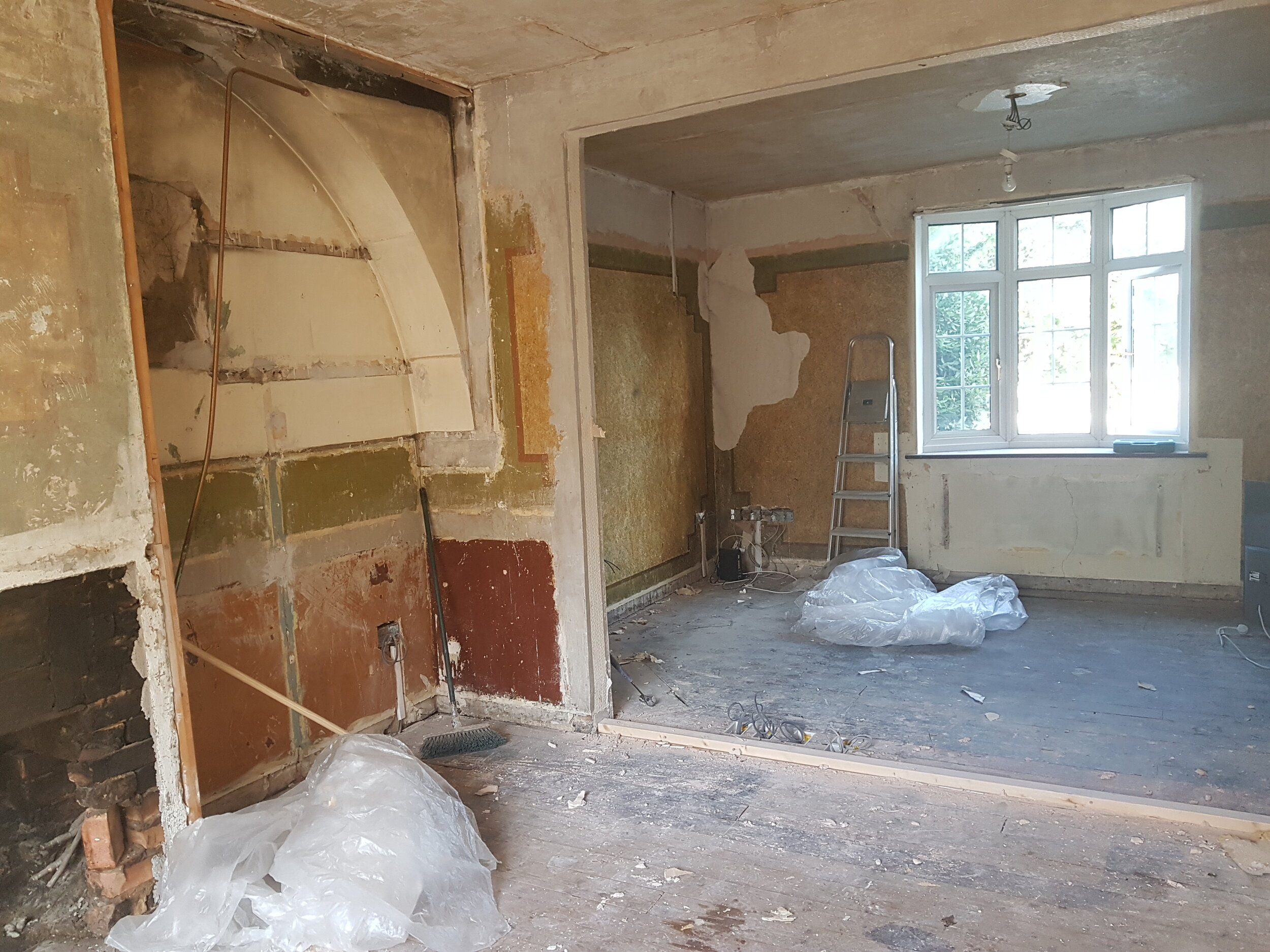
A building site. The wooden floor is dusty. The walls are painted in an art deco style with a slightly eccentric mix of yellow ochre and khaki green with chestnut brown accents. There are wires hanging from uncovered electric sockets. A capped water pipe dangles from one wall. There are dust sheets bundled up. A broom and a ladder propped against a wall. The electric pendant light dangles from a hole in the ceiling.
Well, there was lots of gunk in the central heating system but new radiators and a flush through sorted that out. There was a really weird paint job that we suspect might date back to the 1930s when the house was built. There was some places where the plaster is pulling off the walls and will need to be cut away and replaced completely. There was a set of electrics so dodgy we are now re-wiring altogether. There were floorboards in surprisingly good condition (hooray!) just waiting for sanding and polishing. There was an interesting arch that’s part of the chimney system.
If you go through struggles that you are powerless to prevent, (difficulties in childhood, natural disasters, serious illness, adult trauma and abuse etc) you will develop the mental equivalent of ugly wallpaper, cheap carpet and strange pointless alcoves as a way to feel or appear normal until you feel safe enough to repair the effects of your struggles.
The trouble is, your brain puts up the wallpaper without asking you first. It carpets the floor before you have a chance to object to the colour. It sticks an alcove over things you actually quite like, so you forget they were ever there. In fact, you’re so busy surviving, you don’t even notice that your mental home has changed. By the time you are in a position to do anything about it all, ugly wallpaper, drab carpet and strange alcove seem normal. This is just how you are.
Many of the struggles I wrote about above often involve a financial element. That can lead to the sense of powerlessness and pain connected to the event transferring to your feelings about money. There are also times when money is right at the heart of a painful experience, like losing your job or finding your partner has secret debts.
If you have stopped looking at your finances or told yourself you’re “bad with money” or “not a money person” that’s ugly wallpaper.
Here’s the thing. Until you look underneath, you won’t know where the plaster is pulling away from the wall, so you won’t know what needs repair. You’ll be living in the cold needlessly because you would rather avoid dealing with it than get warm.
More than that, you also won’t know about that arch that could become a cool feature if you let it out. You won’t be able to polish up and enjoy your good solid floorboards.
Personal finance experts often tell you to face facts so you can fix where you’re failing. I’m telling you to face facts so you can discover and celebrate where you’re already better than you knew.
Yes, and fix the bits that need fixing, because you deserve better than cracking plaster and cold radiators.
Are you ready to lift the grey carpet over your money mind?
Try My Money Canvas. It’s a quick, free, simple tool to help you uncover your financial strengths and weaknesses with no maths and no paperwork required.
The cure for being "bad with money"
In spite everything I’ve said in previous blogs, do you still think “I am bad with money”? Does the thought of ever getting on top of your finances seem impossible? Is there some part of your identity, deep within, that rejects the idea that you could ever be good with money? Does even trying make you feel tense and sweaty? Is your stomach doing an awkward, twitchy, little dance just reading this?
It’s ok.
I’ve got you.
Imagine a life in which the end of the month doesn’t feel too different from the beginning. Imagine planning to treat someone you love and being able to go to town without going into debt. Imagine knowing if one of life’s crises crops up, you have the money to cope. Imagine musing on the future you want once your ready to stop working, confident that you’ll be in a position to enjoy it.
What if you could be ok with money? What if you could be fine with money? What if you could be good enough with money?
The good with money/bad with money false binary that I’ve ranted against leaves no room for a more casually comfortable relationship with money. In reality, this is what a lot of people would prefer. Many people would like to be confident they’re doing alright with their finances, but aren’t primarily driven by money.
Does the idea of being good enough with money sounds great, but also a long way from your current situation? That’s ok. You can get there. The key is to start really, really small.
Imagine the types of actions you would take as a person who is good enough with money. Some suggestions:
shop around for deals and cancel unwanted subscriptions, so you don’t waste money on shopping;
learn the meaning of financial jargon and basic economics, so you feel confident in your choices;
save and invest automatically on pay day, so you don’t rely on willpower to make good intentions happen;
pay off borrowed money as soon as possible without incurring extra charges, so you pay as little interest as possible;
negotiate for more pay and lower costs, so you get a great deal;
keep financial paperwork orderly, so you can get your hands on the information you need when you need it;
learn what different financial professionals do and how to choose the right one for your needs, so you can tap into the expertise we all need from time to time.
Choose one of these groups of actions. Now choose a single, small, simple action that fits within this group.
Smaller than that. Nope. Still too big. Think smaller. Think tiny.
Some suggestions for tiny actions:
Search for reviews for one product you are considering buying and bookmark the review to read later, if you can’t read it now;
Find out where you can see the list of subscriptions in your Apple, Google or other mobile payments account;
Learn the meaning of one piece of financial jargon - this is a good list - start with words you’ve seen before;
Find out how to set up a regular automated payment into savings;
Find out if you can overpay any money you’ve borrowed without being charged extra;
Make a list of your achievements at work;
Open one envelope - you don’t have to read what’s inside.
We become confident, not because we’re confident people or by telling ourselves to “be confident”, but by doing what we want to become confident we can do.
There is no such thing as being “bad with money”, but if there were, and if you were, the “cure” would be these tiny actions, one after another, day by day, gradually adding up to better more money in the bank. Do a few tiny actions every week and you’ll be well on your way to being good enough with money.
P.S.
I used to be a financial adviser. It was my job to have a deep understanding of financial products currently on the market and how these could meet people’s needs. I would listen to people’s individual stories and ask questions about those needs, then recommend the products I thought would suit them the best.
As a money coach, I help people understand and improve their psychological relationship with money, so they can be happier that their financial choices are supporting them to build the life they want. There! You’ve completed an action from the last group already! In fact you’ve done it twice. Well done. Go have a cuppa and listen to a song you like.
Do another tiny action tomorrow.
You’ve got this.
"Bad with money" is a fixed mindset
After writing my post about why I don’t think there’s any such thing as being “bad with money” I was curious what other people thought.
I didn’t want to have to explain my whole blog post on social media, so I thought I’d just do a quick LinkedIn poll and see what came back.

Image shows a screenshot of a LinkedIn post and poll by Martha Lawton.
The post says:
“I'm getting increasingly annoyed with the phrase "bad with money". So many people say about themselves "I'm bad with money" and just shrug, as if that's all there is to it.
I don't blame individuals, because this is a common idea, but I think it's super unhelpful.
We can all grow and the label "bad with money" cuts people off from that growth.
What do you think?”
The poll question is “Are some people just “bad with money”?”
The answers are:
“Some people are bad with money” 23% of the votes
“Everyone can improve” 72% of the votes
“Other (please comment)” 5% of the votes
In my previous post I talked about how saying someone is “bad with money” or “good with money” is simplistic and disguises all the many different skills needed to manage money well.
This poll highlights another damaging part of the “bad with money” label. As with almost all labels, it promotes a fixed mindset. For those of you who aren’t familiar with fixed/growth mindsets, I’ll give a quick explanation.
A person with a fixed mindset believes that our skills and abilities have inherent limits beyond which no amount of practice, study and effort can take us. A person with a growth mindset believes we have infinite capacity to develop our skills and abilities as long as we practice, study and work.
A fixed mindset says that talent is everything, you’ve either got it or you haven’t. A growth mindset says that we all start from different places, but where we end up is a combination of our own efforts and the resources available to support us.
It’s worth noting that a growth mindset doesn’t say anything about the rate of progress, only that progress is always possible. Slow improvement still counts. It also makes it very clear that resourcing is important, this isn’t a viewpoint that says the world is a pure meritocracy and there are no structural advantages or disadvantages.
If you say that some people are just “good with money” and others are just “bad with money” and that’s all there is to it, you’re expressing a fixed mindset position about money. The trouble is that it’s a self-fulfilling prophesy. If someone is just “bad with money” why should they try to manage it? They are doomed to failure and might as well give up. Similarly there’s no point is trying to teach or coach anyone to get better with money if it’s just in their nature to be “bad with money”.
One of the people who commented on my post said something similar.

Image shows comment from Penny Delve
“The danger with labelling yourself is that you become that label. Our language is very powerful and our subconscious is always listening 👂.
We all create our own experience so there is a choice. So I voted ‘everyone can improve’ because we always have that choice to change Martha Lawton 🙌”
Not only that, but even people whose fixed mindset puts them in the “good with money” category, can end up very anxious about their money skills. This is because if your ability with money is fixed and you make a mistake or have a financial setback then a fixed mindset says that’s because you’ve reached the limits of your money ability. There’s no way to correct for the mistake in future. A fixed mindset may even tell you that you’re not as ”good with money” as you thought, perhaps even “bad with money” after all.
Worse yet, because in a fixed mindset every skill or behaviour is a fundamental unchanging characteristic of who you are, any time things go wrong that’s a sign you’re a lesser person than you thought. This means that a person with a fixed mindset who gets into debt will either see themselves as a helpless victim and expect someone else to fix the problem for them, or will be too ashamed to ask for help because it feels like exposing their fatal flaw.
It’s an insecure position to be in.
On the other hand, a person with a growth mindset around their financial skills will be actively seeking to improve and will perceive a setback or loss as a chance to learn. They can think clearly about whether they made a mistake or whether they just had bad luck. Neither answer is a threat to their sense of their own value as a person. If something goes wrong with their finances, even a serious debt issue, they will be ok asking for help and will hope that their adviser can help them understand how to fix things now and avoid similar problems in the future. People with a growth mindset tend to be open about their shortcomings because they see themselves as a perpetual work in progress. Today’s failing is tomorrow’s strength.
As you might guess from all of this, people who have a growth mindset about an activity, whether it’s money management, acrobatics or playing the bassoon, tend to achieve more in the long run, because they will usually be more persistent and creative in their approach to developing their skills.
The good news is a fixed mindset can grow into a growth mindset, it’s just a matter of talking about yourself and others slightly differently. Instead of saying “I’m bad with money” or “I’m good with money” (fixed permanent personal traits) you can say “I’m making a habit of tracking my spending, but I don’t do it every day yet” or “I’ve made a plan for my financial future and I’m happy with how well I’m sticking to the plan” (actions and outcomes).
You’ll find you feel more in control with a growth mindset and it will help you to a more secure financial and emotional future.
You can learn more about fixed and growth mindsets and Dr Carol Dweck who did the research around them in this episode of my podcast, Squanderlust.